



THE CULTURALLY INTELLIGENT ENNEAGRAM
Discover integrative wholeness through our unique approach.
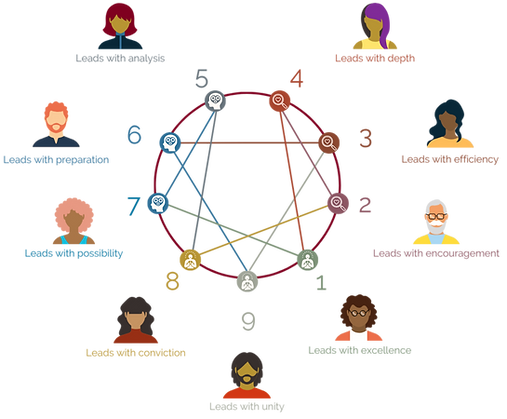
The Enneagram reveals nine personality types, each with a unique worldview that shapes how we feel, think, and act.
The Enneagram [any-uh-gram], or "drawing of nine," uncovers our core motivations and unconscious patterns, helping us understand our stress triggers so we can intentionally choose culturally intelligent responses.
Wholeness emerges when our feelings, thoughts, and actions work in concert. Our Culturally Intelligent (CI) Enneagram approach offers a clear path toward that alignment.
The CI Enneagram reveals how our three Centers of Intelligence—feeling, thinking, and acting—create our unique way of experiencing the world.
When we cultivate:
Curiosity in the heart center (feeling)
Empathy in the head center (thinking)
Compassion in the body center (acting)
...we experience a profound integration that transforms how we relate to ourselves and others.


Now I know how to communicate consistently and collaboratively work with one another—knowing the styles of our various Enneagram types—in holding my team accountable and better supporting them.
—ASHLEY W. | MARKETING VP
The CI Enneagram Series is a first-of-its-kind cohort experience that brings together Enneagram personality theory and CITC's Culturally Intelligent (CI) Leadership Model. Across three in-person sessions (Phoenix, AZ-area) or six online sessions, participants explore how their core motivations, Centers of Intelligence, stress patterns, and security points shape the way they show up—at work, in community, and in relationship with people different from them.
The series is designed as a discovery process, using our founder Dr. Renee Bhatti-Klug's book The Culturally Intelligent Enneagram: Culture, Personality & Integrative Wholeness.
The CI Enneagram Series is also built as its own discovery process—grounded in reflection, scenario-based engagement, and the kind of self-examination that tends to land more honestly than a questionnaire. Most participants confirm their type through the series itself without needing to take a test.
Participants who complete the series are eligible for the CI Enneagram digital badge, awarded through demonstrated integration of Enneagram self-knowledge with CI development.


COHORT 1 (April-May, 2026) | THE CULTURALLY INTELLIGENT (CI) ENNEAGRAM
Alongside the CI Enneagram Series, we offer private coaching and shorter team sessions built around the Enneagram iEQ9 assessment. These engagements serve individuals and teams working within condensed timelines, and we offer the iEQ9 at a discounted rate. Each session applies the same CI lens—curiosity, empathy, and compassion—to the insights the assessment provides. Contact us to design a format that fits your team.
The Enneagram carries wisdom gathered across many cultures. Its roots reach into contemplative traditions that were mapping the human heart long before personality theory existed.
Fourth-century Christian monastics living in the Egyptian desert catalogued the recurring patterns of thought and desire that pull a person away from center. Sufi teachers in the Islamic world developed practices for observing the ego and softening its grip. Jewish mystics worked with structural maps of the soul's descent and return. Ancient Greek philosophers, drawing on Egyptian and Near Eastern sources, understood number and geometry as a language for describing spiritual reality.
The nine-pointed symbol entered Western awareness through G.I. Gurdjieff, an Armenian-Greek teacher working in Moscow and Paris in the early 1900s. He credited the figure to oral teaching he encountered traveling through Central Asia, Turkey, and Egypt.
Modern personality work began in the 1960s and 1970s. Oscar Ichazo, teaching in Chile and Bolivia, connected each of the nine points to a pattern of ego, emotion, and virtue. Claudio Naranjo, a Chilean psychiatrist, brought that framework to Berkeley and joined it with contemporary psychology. Teachers including Helen Palmer, David Daniels, Don Riso, Russ Hudson, and Beatrice Chestnut carried the work forward into the versions most people encounter today.
Portions of this history sit in the documented record. Other portions live in oral tradition and remain open to inquiry. We hold both with respect as we learn.